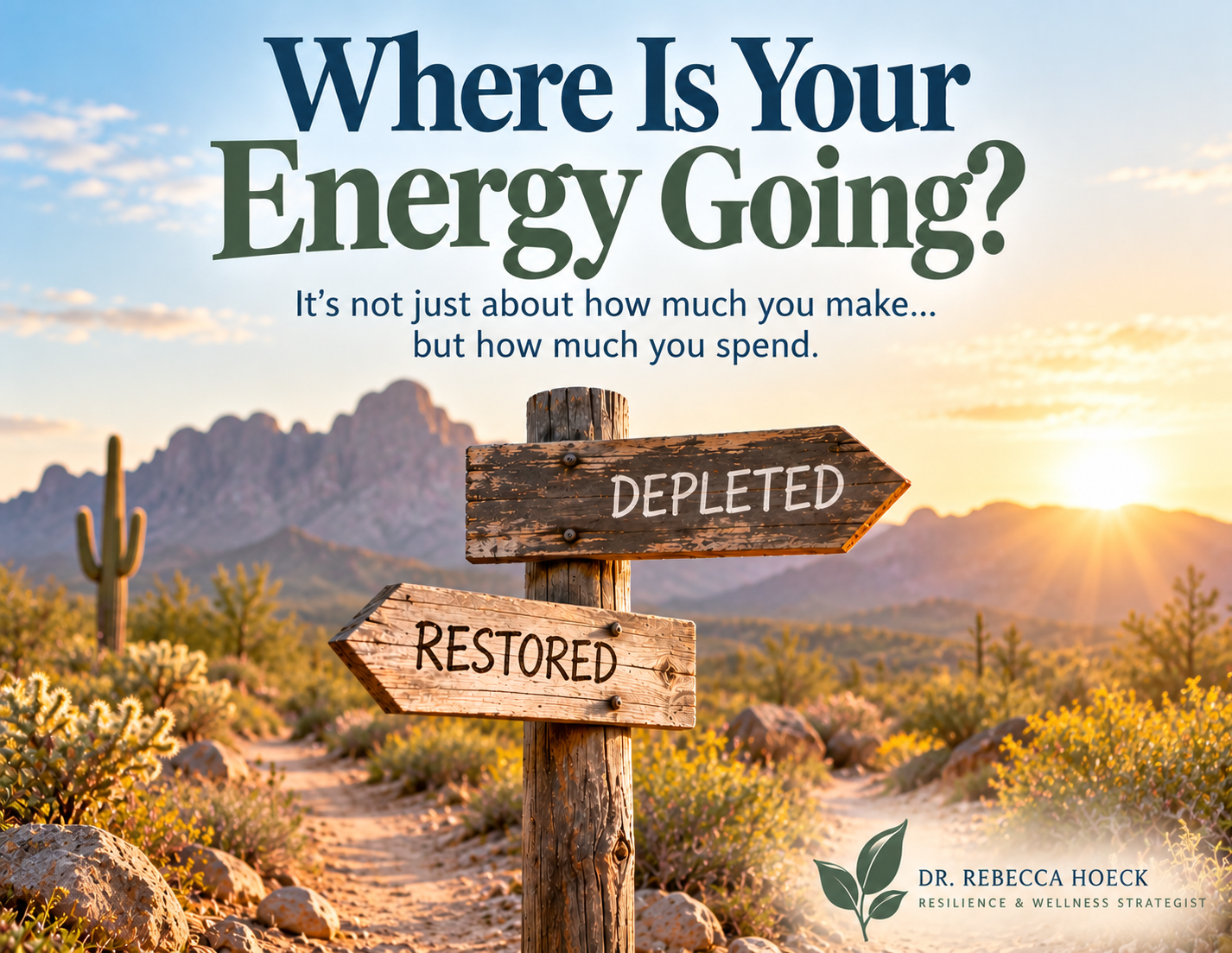
We spend a lot of time talking about how to get more energy.
Sleep more. Exercise. Eat better. Take the right supplements. Drink more water. Manage your stress.
All good advice.
But lately, I’ve been thinking about a different question:
What if the problem isn’t only how much energy we’re making, but how much energy we’re spending?
Your Body Has an Energy Budget
In an earlier post, we talked about how our cells make energy and how ATP acts a little like the currency our bodies use to get things done.
But just like your household budget, making money is only half of the equation.
You also have to look at where it’s going.
Your body has an enormous number of jobs to do every day. It has to keep your heart beating, your lungs breathing, your brain thinking, your muscles moving, your body temperature regulated and your digestive system working.
Then add everything else life throws at it.
Poor sleep.
Chronic stress.
Pain.
Illness or inflammation.
Blood sugar swings.
Emotional stress.
A demanding schedule.
Constant decision-making.
Too much exercise, or not enough recovery.
All of these require resources.
And here’s the important part:
Your body isn’t wasting energy. It’s prioritizing.
If something needs attention, your body will direct resources toward it.
That may mean there is less left over for the things we tend to associate with “having energy”: exercise, concentration, motivation, creativity, patience, social connection or simply feeling like ourselves.
Sometimes We’re Carrying More Than We Realize
I’ve become very aware of this in my own life over the past few months.
Earlier this summer, I wrote about Making Space while helping my mom pack up her home and move into a new one.
She moved.
But apparently, the project got left behind!! 😊
For nearly three months, there has been something else to do at the old house: repairs, remodeling, carpet, cleaning, appointments, decisions, coordinating people and, finally, staging it to sell.
We’re getting close to the finish line.
But I’ve noticed something interesting.
Even on days when I’m not physically working at the house, a little piece of my attention is still there.
Did that get finished?
Who do I need to call?
What’s next?
Did I forget something?
And I realized:
Sometimes the biggest drains on our energy aren’t the things we’re doing. They’re the things we’re still carrying.
Your Invisible Energy Expenses
We all have them.
The unfinished project.
The difficult relationship.
The health concern we keep thinking about.
The overloaded calendar.
The job that follows us home.
The family member we’re worried about.
The decision we keep postponing.
The endless mental list running quietly in the background.
None of these show up on a fitness tracker.
But that doesn’t mean they aren’t costing us something.
Our bodies and brains don’t neatly separate physical stress from emotional stress, mental load and inadequate recovery. They are constantly responding, adapting and trying to keep us functioning.
That is resilience.
But resilience doesn’t mean having an unlimited supply of energy.
A Little Science: Your Nervous System Is Paying Attention
Here’s where this gets interesting.
Your autonomic nervous system is constantly gathering information and adjusting your body to meet the demands of the moment, most of it without you ever thinking about it.
When a challenge requires action, your sympathetic nervous system helps prepare you to respond. Heart rate may increase. Blood pressure can rise. Glucose and other energy resources become more readily available. Digestion may temporarily take a back seat. Stress hormones such as adrenaline and cortisol help mobilize the resources you need.
This is normal physiology.
We need this system to exercise, meet a deadline, respond to an emergency, or simply handle a really demanding day.
The problem isn’t having a stress response.
The problem is not having enough opportunity to recover from it.
Ideally, periods of activation are balanced by periods when the body can shift toward its parasympathetic nervous system, sometimes called our “rest and digest” state.
This is where recovery gets more attention. Heart rate can settle. Digestion is better supported. Muscle tension can decrease. The body has an opportunity to repair, restore and replenish.
But what happens when the demands never seem to stop?
The stressful meeting ends, but we’re still thinking about it.
The family problem isn’t happening at this exact moment, but we’re still worrying about it.
The project is sitting across town, but we’re mentally making tomorrow’s list.
Our bodies are remarkably adaptable, but adaptation still requires recovery.
And that may be one reason prolonged stress can feel so exhausting.
The physical task may be over, but if we’re still anticipating, worrying, planning or problem-solving, our bodies may continue responding as though there is something that requires our attention.
In other words, recovery isn’t simply about stopping the activity.
Our nervous system also needs opportunities to recognize that the demand has passed and shift from responding to restoring.
What If You Didn’t Add Anything?
This may be one of the harder ideas in wellness.
When we feel tired, our instinct is often to add something.
A supplement.
A new exercise program.
A better diet.
A morning routine.
Another strategy.
Another thing to put on the list.
But what if your body doesn’t need another assignment?
What if it needs something taken off the list?
Maybe the better questions are:
What am I carrying right now?
What is requiring more energy than I realized?
What could I simplify?
What can I let go of?
Where do I need more recovery?
And maybe most importantly:
Where am I still swimming upstream?
There it is again.
Because sometimes improving our energy isn’t about trying harder to swim against the current.
Sometimes it’s about noticing the current in the first place.
Take a Look at Your Energy Budget
You don’t need to overhaul your life this week.
Start by noticing.
For the next few days, pay attention to the things that leave you feeling restored, and the things that leave you depleted.
Some will be obvious.
Others may surprise you.
And if you discover that you’re tired, perhaps the first question doesn’t need to be:
“What’s wrong with me?”
Maybe a better question is:
“Where is my energy going?”
Because energy isn’t only about what we put into our bodies.
It’s also about what our bodies, and our lives, are asking us to carry.
A Moment to Reflect
What are you carrying right now?
Is there one thing you could finish, simplify, delegate, postpone or let go of this week?
You don’t have to fix everything.
Sometimes creating a little more space is enough to give your system room to recover.
Symptoms are the message. Resilience is the answer.
If you’ve been feeling depleted and aren’t sure why, Resilience & Wellness Consulting can help you step back and look at the bigger picture, your sleep, stress, movement, recovery, nutrition, health history and the demands being placed on your system.
Sometimes the first step toward restoring energy is simply understanding where it’s going.
Reach out and we’ll start figuring this out together!
Dr. Rebecca Hoeck, PT, DPT
Leave a Reply